
Enterprise AI ROI in 2026
Enterprise AI Research 2026
AI is improving how people work. Far fewer companies can show a measurable effect on earnings. McKinsey's latest global survey explains where the value gap comes from.
Analysis of McKinsey State of AI 2026 and comparable enterprise research
AI is improving how people work. Far fewer companies can show a measurable effect on earnings. McKinsey's latest global survey explains where the value gap comes from.
Analysis of McKinsey State of AI 2026 and comparable enterprise research
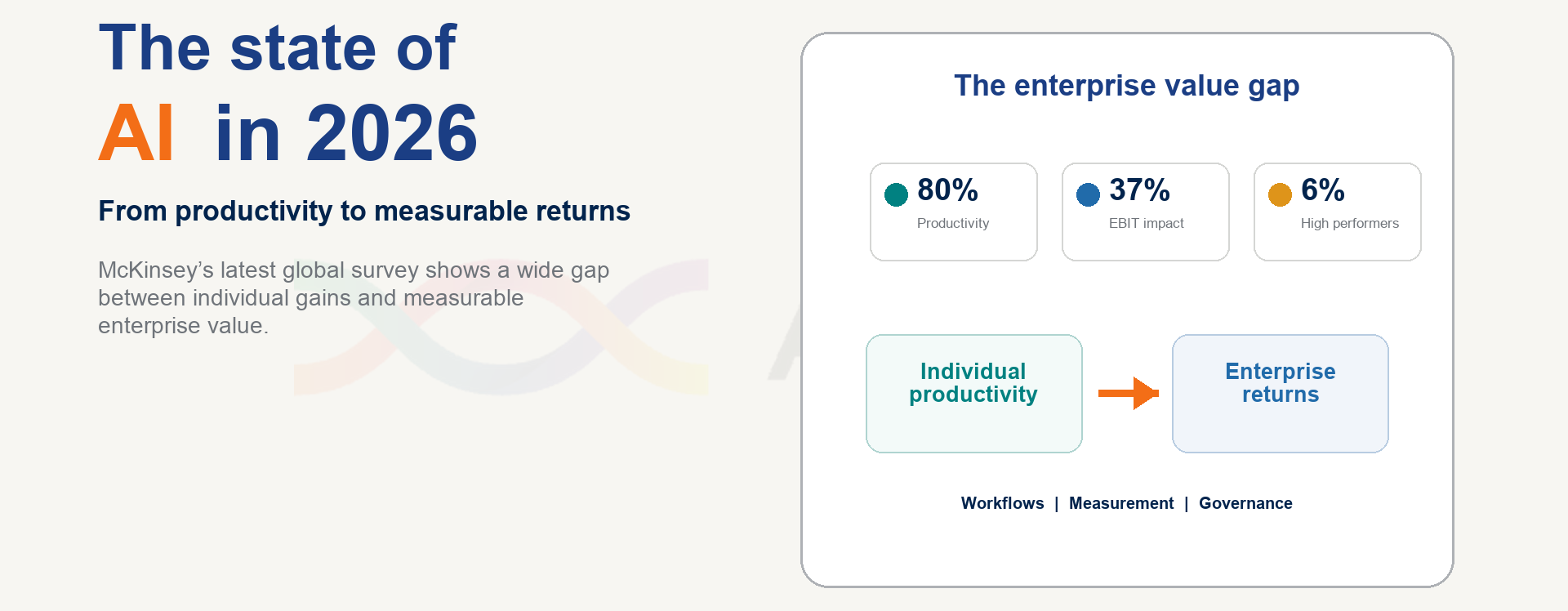
80%
Individual productivity
Individual productivity
McKinsey: respondents say AI improved how they work
37%
Any EBIT impact
Any EBIT impact
McKinsey: any earnings effect attributed to AI
6%
AI high performers
AI high performers
McKinsey: at least 5% of EBIT and a significant impact
Enterprise AI has entered a more demanding phase. Companies no longer need to prove that employees will use the technology. They need to show that widespread use improves operating performance and earnings.
McKinsey's State of AI 2026 survey captures this transition. Eighty percent of respondents say AI has improved their individual productivity, yet only 37% attribute any EBIT impact to AI. Just 6% qualify as high performers, defined as organizations that attribute at least 5% of EBIT to AI and describe the impact as significant.
The survey covered 1,719 participants in 97 countries between 4 May and 8 June 2026. The findings reflect respondents' reported experience rather than audited financial results. Even with that limitation, the gap is striking. Individual gains have become common, while enterprise returns remain limited and uneven.
McKinsey's State of AI 2026 survey captures this transition. Eighty percent of respondents say AI has improved their individual productivity, yet only 37% attribute any EBIT impact to AI. Just 6% qualify as high performers, defined as organizations that attribute at least 5% of EBIT to AI and describe the impact as significant.
The survey covered 1,719 participants in 97 countries between 4 May and 8 June 2026. The findings reflect respondents' reported experience rather than audited financial results. Even with that limitation, the gap is striking. Individual gains have become common, while enterprise returns remain limited and uneven.
Agentic AI is scaling unevenly
Agentic AI has moved beyond experimentation, especially in large enterprises. Forty percent of respondents from companies with more than $1 billion in annual revenue say their organizations are scaling AI agents, up from 27% a year earlier. The comparable share among smaller organizations remained at 22%.
Chatbots are still the most widely scaled AI tool at 47%. About one in five respondents report scaling AI agents or software coding agents across their organization.
Coding agents are also changing software purchasing decisions. Thirty-two percent of respondents say their organization decided not to buy at least one software product or feature because it could build the capability internally with agentic coding tools. The decision can reduce licensing costs, but it shifts spending toward engineering, model use, security, maintenance and governance.
Chatbots are still the most widely scaled AI tool at 47%. About one in five respondents report scaling AI agents or software coding agents across their organization.
Coding agents are also changing software purchasing decisions. Thirty-two percent of respondents say their organization decided not to buy at least one software product or feature because it could build the capability internally with agentic coding tools. The decision can reduce licensing costs, but it shifts spending toward engineering, model use, security, maintenance and governance.
Why productivity does not automatically become ROI
A time-saving tool can benefit an employee without improving the company's profit and loss account. Saved minutes may be absorbed by additional work, duplicated processes, review requirements or poor adoption elsewhere in the workflow.
McKinsey reports that half of respondents make better decisions with AI. Only a minority see an enterprise-level earnings effect. The missing link is often the operating model: how work moves across teams, systems, controls and decision points.
Usage shows that people have adopted a tool. ROI shows that the business has changed an outcome.
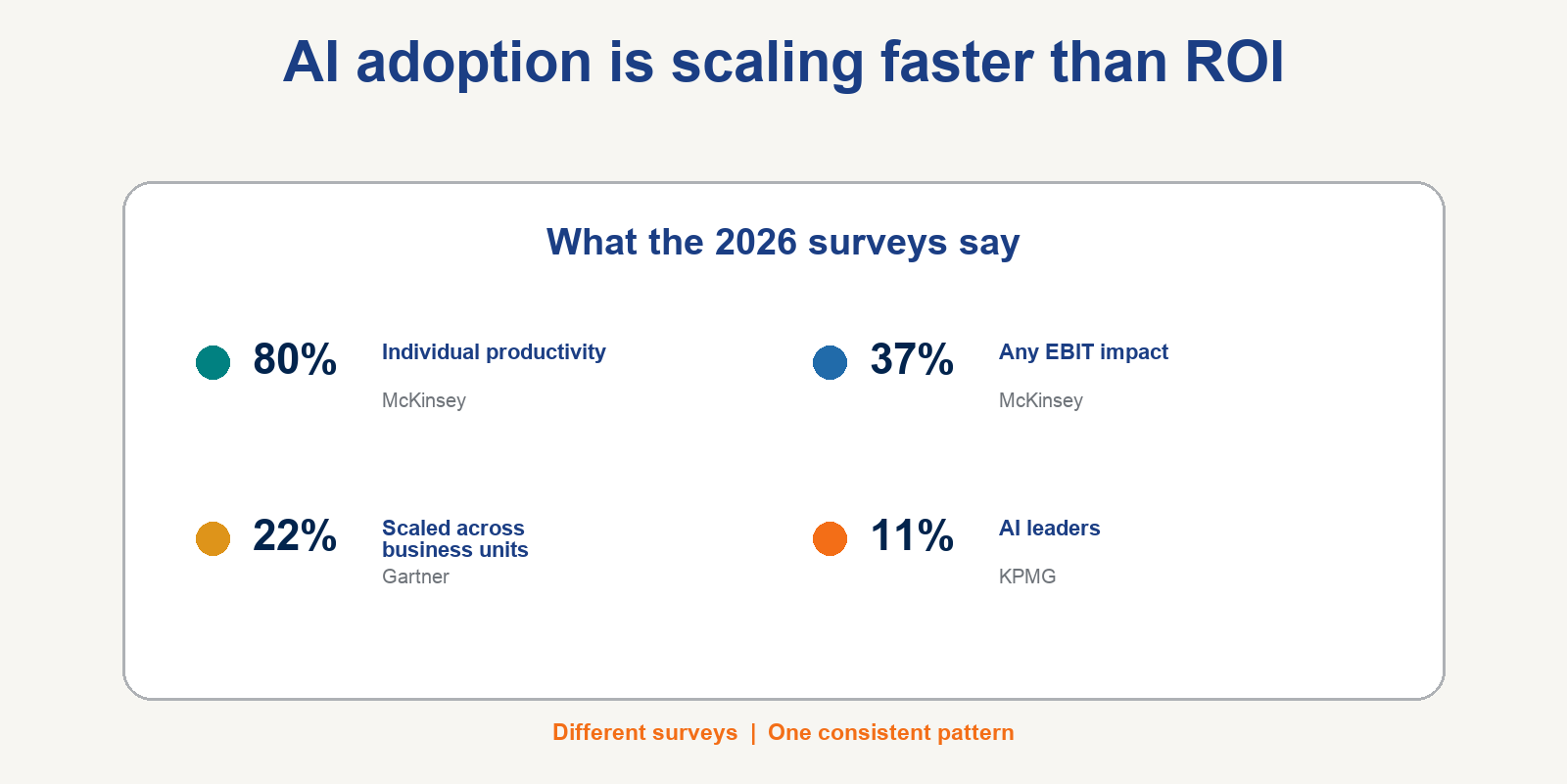
Other 2026 studies point in the same direction. Gartner found that only 22% of organizations had successfully scaled AI across multiple business units or adopted an AI-first approach. Its high performers, which consistently track ROI and reallocate or stop weak initiatives, reported positive returns in 81% of AI projects.
KPMG's Global AI Pulse identifies roughly 11% of organizations as leaders. Their advantage comes from integrating AI into workflows, governance, data and workforce practices rather than deploying a larger number of isolated use cases.
McKinsey reports that half of respondents make better decisions with AI. Only a minority see an enterprise-level earnings effect. The missing link is often the operating model: how work moves across teams, systems, controls and decision points.
Usage shows that people have adopted a tool. ROI shows that the business has changed an outcome.
Other 2026 studies point in the same direction. Gartner found that only 22% of organizations had successfully scaled AI across multiple business units or adopted an AI-first approach. Its high performers, which consistently track ROI and reallocate or stop weak initiatives, reported positive returns in 81% of AI projects.
KPMG's Global AI Pulse identifies roughly 11% of organizations as leaders. Their advantage comes from integrating AI into workflows, governance, data and workforce practices rather than deploying a larger number of isolated use cases.
What AI high performers do differently
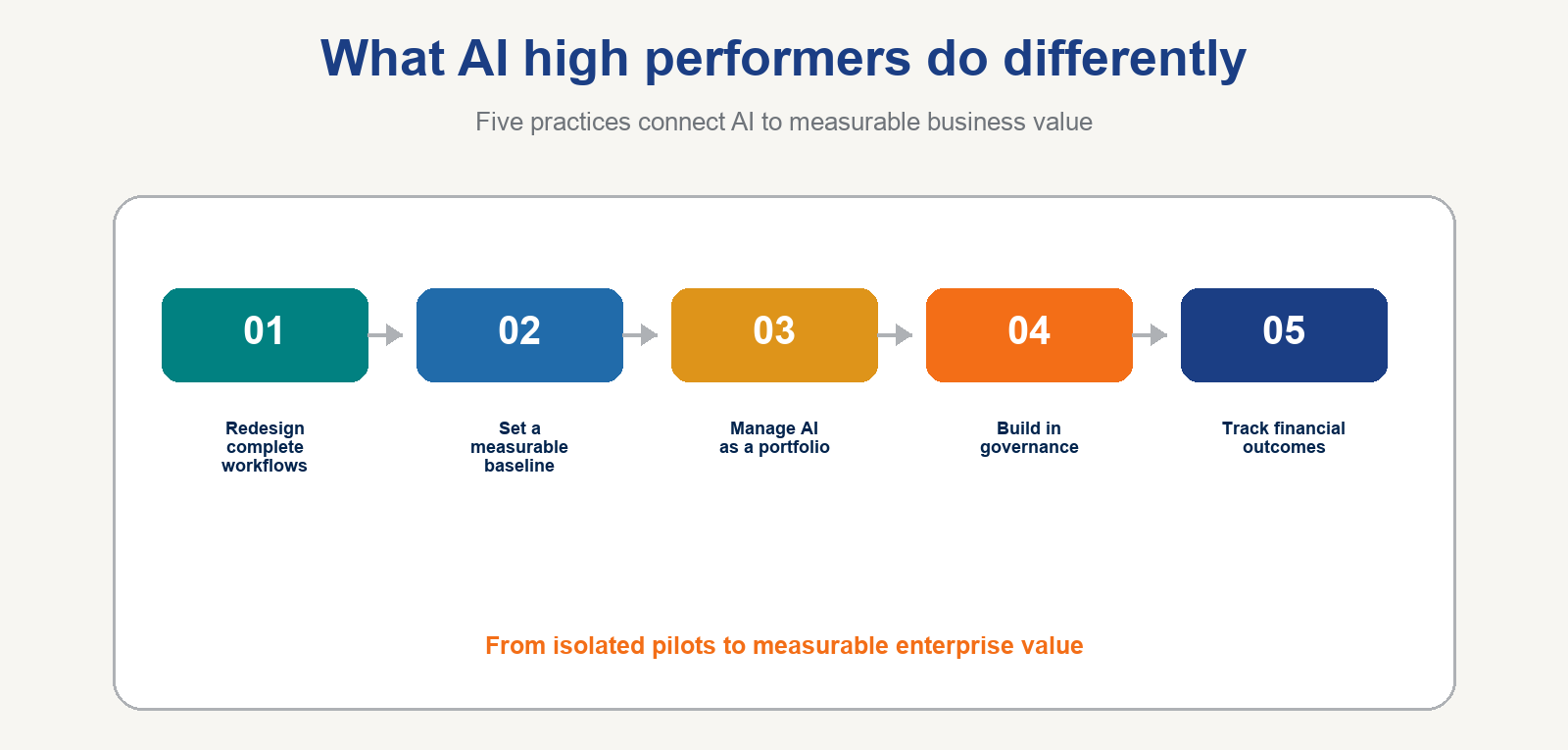
Five practices connect AI to measurable business value
Five practices connect AI to measurable business value

Redesign complete workflows
Set a measurable baseline
Manage AI as a portfolio
Build in governance
Track financial outcomes
McKinsey's high performers are twice as likely as other organizations to report visible senior-leader commitment and defined processes for measuring impact. They are also more than three times as likely to be scaling agents in most business functions covered by the survey. The survey shows an association rather than proof of causation, but the practices provide a useful checklist for moving from pilots to enterprise deployment.
A practical framework for measuring AI ROI
Start with one workflow
Record the current baseline
Count the full cost of AI
Compare results with the baseline
Separate activity from value
Connect the change to money or risk
Start with one workflow and a measurable business outcome. Record the current cost, cycle time, error rate, conversion rate, revenue or risk exposure. Include the full cost of the AI system: model use, integration, data preparation, monitoring, security, human review and change management.
Measure the result over a defined period and compare it with the baseline. Use a suitable control group where possible. The scorecard should separate employee activity from business value. Users, prompts and hours saved help explain adoption, but they are not ROI. A credible calculation connects the AI-enabled workflow to lower cost, higher revenue, reduced risk or released capacity that the organization can actually redeploy.
Execution will determine the next enterprise AI gap
AI investment is likely to keep rising even as executives demand clearer evidence. McKinsey says most respondents plan to increase spending, although about 20% report that operating costs, including token costs, have already constrained use.
Gartner found that 85% of functional leaders planned to increase AI spending in 2026 after allocating an average of 12% of their functional budgets to AI in 2025. Companies that establish baselines, redesign workflows, govern agents and measure financial outcomes can turn individual productivity into enterprise value.
Gartner found that 85% of functional leaders planned to increase AI spending in 2026 after allocating an average of 12% of their functional budgets to AI in 2025. Companies that establish baselines, redesign workflows, govern agents and measure financial outcomes can turn individual productivity into enterprise value.
Sources
The cited studies use different populations and definitions. Their percentages should be compared directionally rather than combined into one dataset.
Contact us
Translating AI usage into measurable business value
Review your AI portfolio against clear operational and financial baseline values and focus investments on workflows with demonstrable results.
Discuss AI ROI Roadmap
Those wishing to practice the transition from pilot project to measurable impact will find three starting points: AI-Native Foundations, AI-Native Value Architect, and the working session Leading the AI-Native Organization. The context for the reports for the board can be found in AI Reports 2026.
Review your AI portfolio against clear operational and financial baseline values and focus investments on workflows with demonstrable results.
Discuss AI ROI Roadmap
Those wishing to practice the transition from pilot project to measurable impact will find three starting points: AI-Native Foundations, AI-Native Value Architect, and the working session Leading the AI-Native Organization. The context for the reports for the board can be found in AI Reports 2026.
Upcoming AI-Native training courses